
By Islam Abdullah, Founder of Reverse Mindset Academy
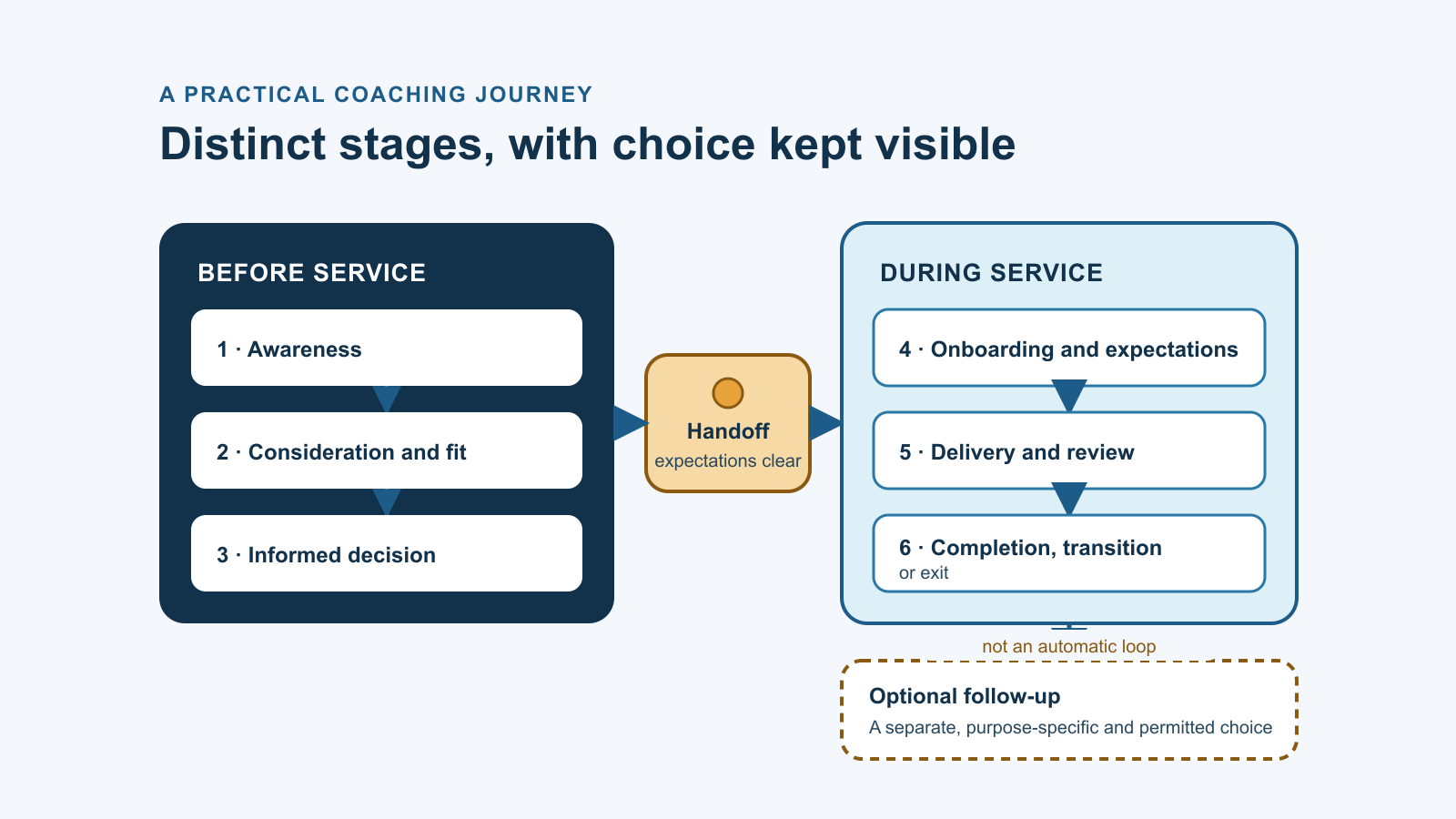
A client journey can look simple from inside an established coaching practice. Someone finds the business, decides whether the offer fits, books and begins the work.
The lived experience is usually more detailed. Before service, a person may need enough information to understand relevance, boundaries and the next step. During service, they need clear expectations, communication and delivery. After service, any follow-up should have a specific purpose and appropriate permission rather than becoming an automatic marketing loop.
Mapping these stages does not mean turning a human relationship into a funnel. It means making the information and handoffs visible enough to examine. That can help a practice notice where people are asked to guess, where responsibility is unclear or where different purposes have been blended together.
Separate the buyer journey from the service-delivery journey
The stages below are a practical article map, not RMA’s product pathway and not a universal sequence for every coaching practice.
The buyer journey and the service-delivery journey connect at important handoffs, but they are not the same. Look at each stage from both sides: What does the person need, and what does the practice need to do next?
Two-sided journey swimlane
| Stage | What the person needs | What the practice does next |
|---|---|---|
| 1. Awareness | Understand what the practice is and whether it may be relevant. | Present relevance, scope and important boundaries in plain language. |
| 2. Consideration and fit | Understand who the work is for, what it involves and how to take the next step or decline. | Make fit, non-fit, commitments and the enquiry path clear without pressure. |
| 3. Informed decision | Understand the engagement, practical commitment and relevant terms. | Answer relevant questions, support a free choice and confirm only what is agreed. |
| 4. Onboarding | Know what happens next, where questions belong and what each party can expect. | Collect only what the agreed service needs, set expectations and name the next step. |
| 5. Delivery and review | Receive the agreed work and clear service communication. | Deliver within the described boundaries and make any agreed review point clear. |
| 6. Completion, transition or exit | Know what is complete, what they retain and whether anything further is optional. | Close the agreed work and necessary administration clearly; do not make continuation the default. |
Awareness does not make someone a lead in every system or create permission for unrelated contact. A prospective buyer, an active client and a person whose service has ended have different needs, purposes and information boundaries.
Core journey ends here
Completion, transition or exit is part of the agreed core path. Necessary closing administration belongs with that purpose. It must not be blurred into an automatic continuation or marketing loop.
Any later request sits on a separate, optional and purpose-specific branch:
- feedback;
- marketing;
- testimonial;
- case study;
- referral request; or
- advocacy request.
Each purpose needs its own explanation and appropriate permission. Declining or withdrawing from an optional request must not change access to, care within or the value of the agreed core service.
Map where the journeys connect
The most useful places to examine are often the handoffs between stages. This is where a person’s question, a business task and a change in responsibility meet.
Informed decision and fit
Ask what a suitable person needs to know before deciding. Can they understand the offer without decoding internal language? Are the next step and important boundaries visible? Is there a clear route for a genuine question?
The aim is not to persuade everyone. It is to help the right person make a more informed choice while making it easier for someone else to recognise that the service is not their next step.
Onboarding and expectations
The handoff from decision to service should explain what has changed. The person is no longer only considering the offer; they are entering an agreed service relationship.
Review what information is requested, why it is needed, who can access it and how it supports the service. Collecting more information “just in case” can create risk without improving the experience.
Also make expectations practical. Clarify communication channels, response boundaries, preparation and what will happen if a plan needs to change. This is not about removing every uncertainty. It is about preventing avoidable guesswork.
The first delivery handoff
The first delivery handoff is the point where promises in the buying journey meet the actual service.
Check whether the language, boundaries and expectations remain coherent. If the marketing describes one experience while onboarding introduces another, the client may have to reconcile the difference themselves.
Do not assume that every practice needs the same stages or tools. The useful question is whether the current handoff gives the person and the practitioner enough clarity to proceed responsibly.
Make information, operational responsibility and consent visible
What the person needs to know at each handoff
For each stage, write down the minimum information a person needs to make the next informed decision or participate in the agreed service.
Before service, that may include relevance, scope, important boundaries and the next step. During service, it may include practical expectations and service communication. After service, it may include completion information or a separately explained optional request.
Keep the wording at the reader’s altitude. Internal process labels may be precise for the business but confusing to someone outside it.
Who is currently responsible for the next step
Record who currently handles the handoff and what ready-to-proceed means. “Operational responsibility” describes the current process; it does not appoint a role, create a reporting line or transfer authority.
If the responsibility changes, the next person should receive only the information needed for that purpose. A handoff should not become permission to copy sensitive information across systems or teams.
What permission or preference applies to the specific purpose
Service communications needed to deliver an agreed service are different from optional marketing, testimonial, case-study, referral or advocacy requests. Before any optional contact or use, explain the purpose, channel, information involved, intended audience and how the person can refuse or withdraw. Refusal or withdrawal must not reduce access to the agreed core service. Collect and retain only the information reasonably necessary for the stated purpose, and keep prospect, active-client and former-client uses appropriately separated.
For optional electronic marketing:
Use the applicable consent basis, identify the sender and provide a working unsubscribe. Do not send an electronic marketing message merely to ask for marketing consent.
Silence, service purchase or existing-client status is not universal consent. Optional feedback, testimonial, case-study, referral and advocacy requests should be separately explained and non-pressuring. Continued access, care quality or core-service value must not depend on participation.
Describe follow-up by its actual purpose: service delivery, service administration, feedback, optional marketing or a referral request. Clear labels help people understand the choice and help the practice avoid reusing information beyond the reason it was collected.
Examine gaps using current evidence
Notice delays, repeated explanations and unclear next steps
Look at what the current journey can show. Where do people ask the same practical question? Where does a task wait because the next step is unclear? Where does the practitioner have to repeat information that could have been available earlier?
These signals may justify a closer look, but they do not prove the cause. A delay may reflect timing, fit, capacity, missing information or a decision outside the practice’s control.
The wider context is that client flow works as a connected system. That does not mean every journey gap is a marketing problem or that changing a handoff will produce a commercial result.
Separate a signal from an assumed cause
Write the observation first. Then list possible explanations without selecting one prematurely.
For example, repeated clarification may show that information is hard to find, that the language is unclear or that people need a real conversation before deciding. The correct response will depend on which explanation the evidence supports.
Client experience continues after the first booking, but the surrounding article is contextual rather than causal. It does not prove that a particular handoff caused an enquiry, conversion or retention pattern.
Avoid behavioural surveillance, inferred sensitivity and collection “just in case.” Use the minimum information needed for the stated stage and purpose. A map should improve clarity, not create a reason to monitor people more closely.
Choose one stage for a bounded review
Create one handoff clarity note
Choose the handoff that is currently least clear. Use the swimlane to record only what is needed:
Stage and purpose: [stage / purpose]
Person needs to know: [plain-language need]
Practice action: [current action]
Minimum information: [category only]
Currently responsible: [current role or function]
Ready for the next stage when: [condition]
Boundary: [Agreed service / Completion or exit / Separate optional purpose]
One clarification to examine: [bounded change]
Make the smallest useful clarification rather than redesigning the whole journey. The note describes the current process; it does not appoint a role, authorise contact, prove consent or promise an outcome.
Define what would show whether the review was useful
Choose evidence that matches the purpose. If the aim is clarity, look for whether repeated questions change or whether the handoff can be completed without avoidable guesswork. If the purpose is service administration, check whether the necessary information reaches the right person at the right time.
Do not turn the measure into a conversion, retention, referral, advocacy, growth or client-experience promise. A useful review can improve understanding without guaranteeing a business or client outcome.
RMA publicly describes its own route only as Snapshot → Audit → Decide. That is the public route RMA describes, not the universal article map above. The Snapshot does not perform journey mapping, the Audit does not implement a client journey, and no later service is implied to be publicly available here.
Which handoff in the current client journey is least clear?
Take the 19-question Client Flow Snapshot for an immediate on-screen directional view of six connected areas. The form does not require your name, email address, client information or financial figures. It does not establish root cause or tell you that a particular solution is required.