
By Islam Abdullah, Founder of Reverse Mindset Academy
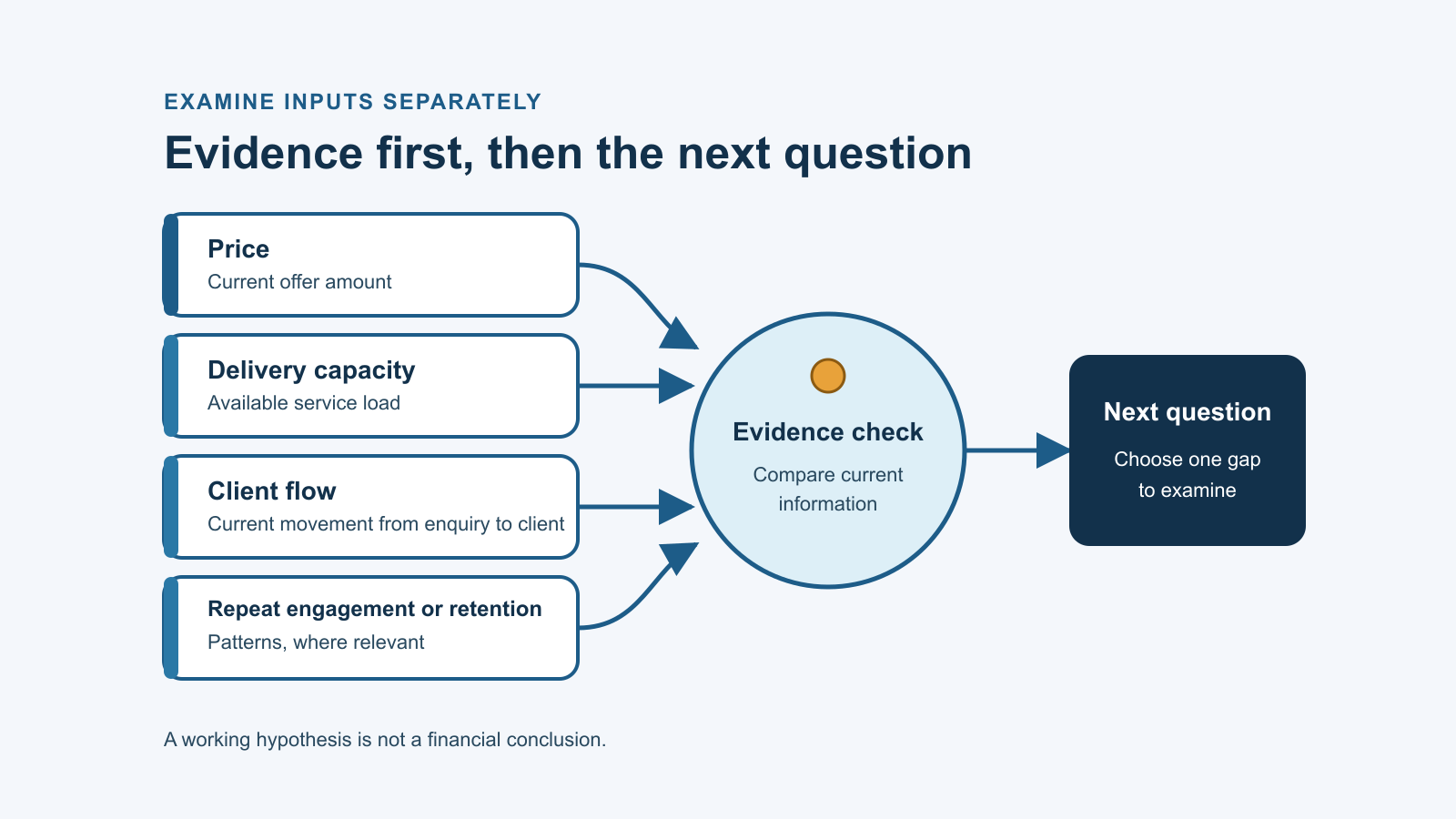
Inconsistent coaching income can create pressure to change something quickly. A quieter period may lead you to question your price. A busy period may make you think the current model is working. When the pattern changes again, it can be difficult to tell which conclusion was useful.
The problem is that the word “income” often compresses several different questions into one. Money received by the business, business expenses, timing, delivery capacity and client-flow patterns can move differently. Looking at them as one issue can make the next decision less clear.
A calmer starting point is to separate the operating inputs, gather what the business can currently show and form a working hypothesis. That will not produce a financial conclusion. It can help you identify the next question and whether it belongs in commercial review, operational review or appropriately qualified professional advice.
First, clarify revenue, income and cash flow
In this article, revenue means money received by the business before business expenses; profit means revenue after business expenses; and cash flow describes the timing of money moving into and out of the business. “Income” can mean different things in ordinary, accounting and tax contexts, so confirm the definition relevant to your circumstances with a suitably qualified accountant or registered tax agent.
Why the terms are related but not interchangeable
Revenue can change while cash timing creates a different immediate experience. A full delivery schedule can coexist with unclear profitability. A quieter client-flow period can feel like the whole explanation even when other business inputs also changed.
These relationships matter, but none proves cause by itself. The purpose of separating the terms is to stop one visible pattern from becoming an unsupported conclusion.
For example, asking “What changed in revenue?” is a different question from “What changed in cash timing?” Asking “What can the practice sustainably deliver?” is different again. Clearer questions help you gather information that belongs together.
When a suitably qualified accountant or registered tax agent is the right next step
Some questions are operational. You can review how the offer is structured, what delivery capacity is available, how enquiries move and what repeat engagement or retention patterns are relevant to the business model.
Other questions require professional advice. If you need a definition or decision for tax, accounting, legal obligations or your personal financial circumstances, use a suitably qualified adviser. An operating review should not be stretched into advice it cannot safely provide.
General educational information—not tailored advice
This article provides general educational information about business operating inputs. It does not take your circumstances into account and is not financial-product, tax, accounting or legal advice. It does not recommend a price, income target, financial product or course of action. Seek appropriately qualified advice before making decisions in those areas.
The aim is not to tell you what to charge or how much the business should earn. It is to make the operating questions visible before several parts of the business are changed at once.
Evidence or explanation?
Separate the evidence before you explain the pattern.
The fictional example below uses category-level observations only—no prices, earnings, expenses, client records or personal financial circumstances. It does not diagnose inconsistent income, establish cause or provide financial advice.
Start with one sentence about what the current information shows. Then move through five checks:
- Write the observation. Describe what is visible without adding a reason.
- Check the definition and period. Ask whether the same term and review period are being used throughout.
- Check comparability. Decide whether the information can be compared fairly, or whether something is missing or not comparable yet.
- Hold possible explanations apart from evidence. List what may be worth examining without selecting a cause.
- Choose one next-review question. Ask what would help support, weaken or replace the explanation.
A fictional decision path
Begin with the observation: “Enquiries appeared in clusters.”
Work through the checks and keep the information-quality question separate from any explanation of income.
Operating-review note
Use this structure to carry the reasoning forward:
What is observed
Enquiries appeared in clusters during the period being reviewed.
What is missing or not comparable
Enquiry-stage labels changed during the period, so movement between stages cannot yet be compared consistently.
Possible explanations held
Visibility, offer clarity, timing, fit or the enquiry process may be worth examining. None is established as the cause.
Next review question
Can one consistent stage vocabulary be used for the next bounded review so the information becomes easier to compare?
Keep the four operating inputs separate
The decision tool can be used with four different inputs. They may relate to one another, but none should be treated as the whole explanation.
Price and offer structure
Review what is offered, whether the options are described consistently and whether a suitable person can understand the different delivery commitments. This does not reveal a “correct” price or show that price explains an income pattern.
Available delivery capacity
Look beyond appointment slots to the preparation, administration, communication and recovery needed to deliver responsibly. Capacity can shape what the practice supports, but it does not prove why revenue changed or justify increasing workload.
Client-flow cadence
Client flow includes how suitable people find the practice, understand the offer, enquire and decide whether to proceed. Client flow works as a connected system, but a clustered or uneven pattern does not identify its cause. An inconsistent enquiry pattern can have several possible explanations; that context is not evidence that client flow caused a particular income result.
Repeat engagement or retention patterns, where relevant
Use this input only where it fits the business model. Separate intended completion from optional continuation and do not assume that longer continuation is better. The pattern can frame a question; it does not establish a target or explain income.
Snapshot does not diagnose income or calculate pricing. Audit may examine relevant evidence and identify a directional priority, but it does not prescribe a correct price, provide financial advice or forecast an outcome. No causal, diagnostic or prescriptive RMA product connection is implied by these four inputs or the article’s discussion.
None of the four inputs proves cause or supports a universal formula.
Gather the current business information
What is known from offers, capacity, client-flow records and repeat engagement or retention patterns, where relevant to the business model
Start with information the business already controls. Review the current offer descriptions, the delivery commitments attached to them, available capacity and the records used to understand enquiries. Where it is relevant, look at aggregate repeat-engagement or retention patterns.
Keep the review at the category or business-pattern level. You do not need to submit financial figures, client records or personal financial circumstances to follow this process. Do not move sensitive client information into a marketing or editorial document.
Write down what the information actually shows. A record may show when an enquiry arrived or whether a service continued. It may not show why the person made that decision. Preserve that distinction.
What is missing, inconsistent or not yet comparable
Some records may use different definitions or periods. Capacity may be described informally. Offer names may have changed. A follow-up category may combine service communication with optional marketing. These are information-quality questions before they are performance conclusions.
Name the gap plainly. If the available information cannot support a comparison, do not force one. “Not yet comparable” is a useful finding because it prevents a weak pattern from being treated as certainty.
Keep explanations provisional
An observation describes what the available information shows. A possible explanation describes what might be contributing to it. Those are not interchangeable with evidence of cause.
Use language such as “may be contributing,” “appears worth examining” or “is not yet clear.” Define what you would need to see to support, weaken or replace the explanation.
Avoid changing price, offer structure, marketing activity and delivery capacity together merely because the overall pattern feels uncomfortable. When several variables move at once, it becomes harder to learn what mattered. One bounded clarification can improve the next review without pretending the first explanation is correct.
Choose one information gap for the next review
Decide whether the next question is commercial, operational or professional-advice territory
End the review by naming one information gap and its proper owner.
A commercial question may concern how the offer is structured or understood. An operational question may concern capacity, handoffs or the consistency of business records. A tax, accounting, legal or financial-product question belongs with an appropriately qualified professional who can consider the relevant circumstances.
You do not need to resolve every uncertainty at once. Ask: What information would help you examine the current pattern more carefully?
That question does not remove uncertainty, but it puts the next step on firmer ground.
Take the 19-question Client Flow Snapshot for an immediate on-screen directional view of six connected areas. The form does not require your name, email address, client information or financial figures. It does not establish root cause or tell you that a particular solution is required.