
By Islam Abdullah, Founder of Reverse Mindset Academy

Your practice is operating. Clients are being supported. Enquiries are arriving. Work is getting done.
But ordinary tasks keep finding their way back to you.
An enquiry sits unanswered while you are with clients. A follow-up depends on you remembering it at the right moment. A delivery question waits because the answer lives in your head. A small decision pauses the work because nobody—or no simple system—can move it forward without you.
This does not mean you are incapable or managing the practice badly. It may mean the way the practice holds information, decisions and responsibilities has not yet caught up with the work you are doing.
The first useful step is not to label yourself “the bottleneck.” It is to see where the practice depends on your attention before deciding what needs to change.
What owner dependency can look like
A practice will always depend on its owner for some decisions. Your judgement, professional standards and understanding of the work matter.
The concern is not that you are involved. It is that too many ordinary parts of the practice may stop when your attention moves elsewhere.
An owner-dependent point is not simply work you personally choose to do. It is a recurring step that cannot move because the next safe action, required information or decision boundary exists only in your attention. Clear processes can make responsibility and routine decisions visible without trying to standardise the professional judgement that should remain yours.
Four patterns are worth examining.
Enquiries wait when client work becomes busy
You may respond carefully when you have space, then lose visibility when the week fills up. The problem is not a lack of care. The enquiry process may depend on you noticing every message, remembering its status and deciding the next step from scratch.
If you are unsure where enquiries slow down, it can help to look at why client enquiries stay inconsistent before adding another way for people to contact you.
Follow-up depends on memory
You know who asked for more information, who wanted to check their calendar and who planned to return later. But that knowledge may be spread across your inbox, messages, notes and memory.
Nothing is necessarily missing because you do not care. The next action may simply have no clear place to live.
Important decisions stay in your head
You may be the only person who knows why a service is offered in a particular way, which enquiries are a good fit, what information should be sent or what needs to happen before a client begins.
Even if you work alone, keeping every decision in your head makes the practice harder to review. It also means you have to solve the same question again when the situation returns.
Delivery pressure increases as more clients arrive
More clients do not only add appointments. They can also add preparation, administration, communication, follow-through and decisions.
When those surrounding tasks still depend on one person, a fuller calendar can create more strain without making the practice feel more secure. The client work may be strong while the business around it remains fragile.
Why a busy practice can still feel fragile
Busyness shows that work is happening. It does not show whether the practice can handle that work consistently.
A practice can look successful from the outside and still rely on the owner to connect every step. When you are available, the gaps may be hard to see because you quietly bridge them. You answer the message, find the document, explain the exception and remember what comes next.
The pattern often becomes clearer when you are occupied with client delivery, taking time away or dealing with several demands at once. Work slows because the next step was never made visible outside your own attention.
Looking at the wider client journey can help you see enquiries, follow-up and delivery as connected experiences rather than separate tasks.
Start with the point where work pauses
It is tempting to respond with a large solution: new software, a virtual assistant, a customer relationship management system or more automation.
Those options may become useful. But they cannot tell you which decision is unclear, which information is missing or which part of the work should remain yours.
Automating an unclear process can make the confusion move faster. Delegating work without the right context can create more questions. Adding software can create another place to check.
Before choosing a tool, reverse the pause:
- Why: Why does this step matter to the client or the practice?
- Who: Who is waiting, acting or responsible for the next move?
- Outcome: What safe, useful result should be visible?
- System: What information, rule or record would support that result?
- Sequence and action: What is the smallest next step, and what must still come back to your judgement?
- Evidence: What would show that the work moved more clearly—or that the real constraint sits somewhere else?
A tool may support a clear process. It cannot decide which parts should remain professional judgement, which routine steps need a visible rule or what information the practice must protect. If the issue is repeated administration or scattered information, business systems may help after the work itself is understood. Allied-health practices can also assess any proposed system against their clinical and administrative needs, practice size, integrations, training, security and support using AHPA’s Clinical Information Systems guidance.
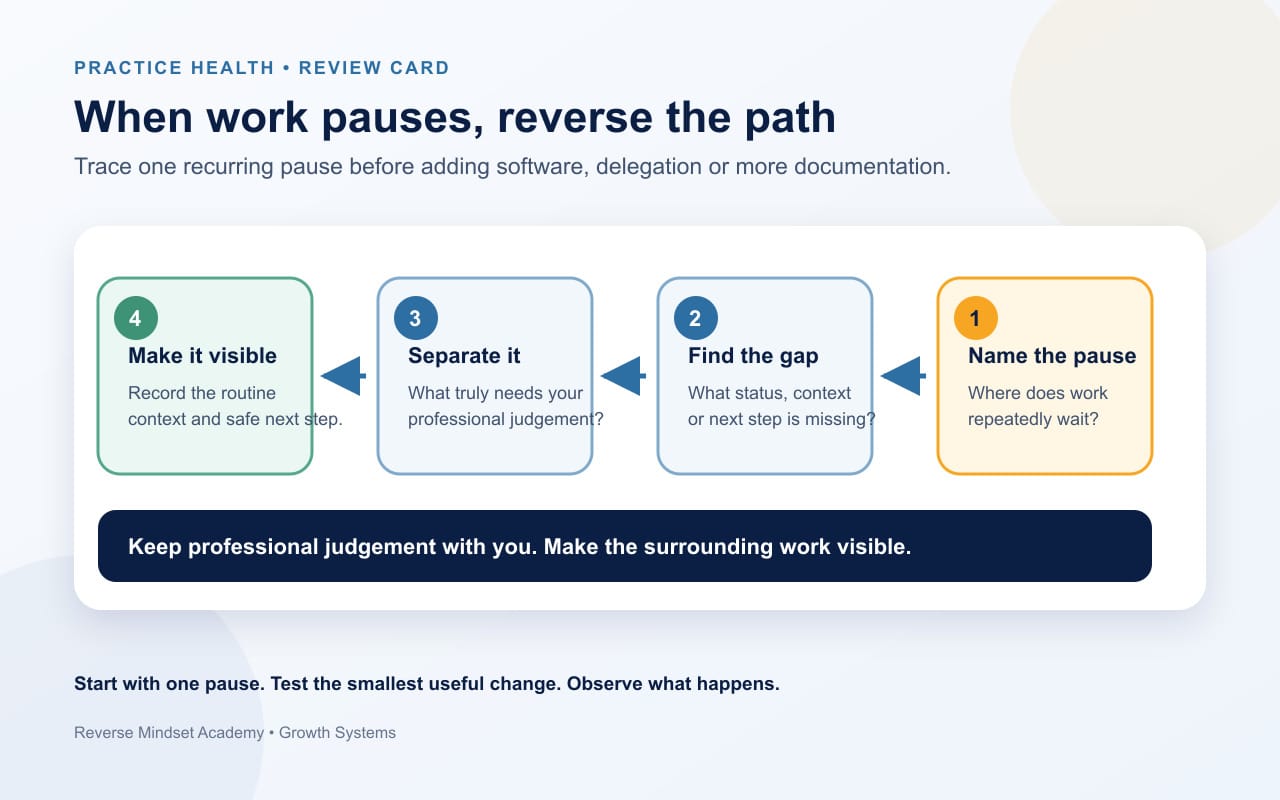
Illustrative example—not a client case: A website enquiry arrives while the practitioner is in session. The practitioner may still need to decide whether the service is a suitable fit. But an approved acknowledgement, a visible enquiry status and a defined review time can stop the routine part from disappearing into memory. The system does not make the professional judgement; it makes the work around that judgement visible.
Try one small owner-dependency review
Choose one recurring moment from the last week when work waited for you. Keep the exercise narrow. Australian Government guidance on reviewing processes and bottlenecks may provide a useful broader reference, but this exercise does not assume that every pause is a process problem.
1. Name the pause
Write one plain sentence.
For example: “A new enquiry waits until I have time to write a reply” or “A delivery question returns to me because the next step is not recorded.”
This is a description of the work, not a judgement about you.
2. Write what the next step requires
List only what someone—or a simple system—would need to move the work forward.
That might be:
- the relevant information;
- the next action;
- the person responsible;
- the boundary that needs your judgement; or
- the place where the outcome should be recorded.
3. Separate judgement from repetition
Some decisions belong with you. Others only return to you because the usual answer has not been documented.
This distinction matters. The goal is not to remove you from the practice. It is to protect your attention for the work that genuinely needs it.
4. Make the smallest practical clarification
You might write a short response guide, add one status to an existing list, record a decision rule or place a repeated instruction where it can be found.
Do not rebuild the whole practice. Make one recurring point easier to understand, then observe whether work moves more clearly.
The aim is a practice that supports your judgement
A healthy practice does not need to run without you. It needs to make good use of you.
Your expertise should shape the service, the standards and the important decisions. It should not be consumed by repeatedly finding information, remembering routine follow-up or reconnecting steps that the practice could hold more clearly.
Choose the point of greatest dependency first. Make it visible. Then decide whether the right response is a clearer process, a better record, a tool, support from another person or no change at all.
If you want an optional way to examine the wider client-flow picture, the free Client Flow Snapshot can help you recognise areas that may deserve closer attention. It is a starting point, not a definitive diagnosis.