


A small business process improvement example: when to keep a change
This fictional small business process improvement example shows how to judge a change by what it achieves, while protecting what already works.

In today’s fast-paced, hyper-connected world, the desire to make a meaningful impact through coaching or therapy is stronger than ever. People are increasingly looking for ways to escape the corporate grind and pursue a career that aligns with their passions and values. But here’s the challenge—many are focused solely on the results, the external markers of success like making money or gaining recognition, without dedicating enough time to the work that truly matters. That work comes from within.
Imagine walking up to a fireplace and saying, “You give me heat, and I’ll give you wood.” It sounds absurd, doesn’t it? But that’s exactly what happens when we demand results without investing in the inner work required to achieve them. The journey to success, especially in coaching or therapy, is much like building a fire. You need to gather the wood, carefully arrange it, and tend to it with patience and care before you can enjoy the warmth it provides.
This is the reason why we are called Reverse Mindset Academy—because we think differently than the majority. While many are chasing quick results and superficial success, we believe in reversing that mindset. We prioritize the foundational inner work, knowing that it is the true catalyst for sustainable success. At Reverse Mindset Academy, we understand that the path to success is not just about the end goal—it’s about the process of transformation that happens along the way. That’s why we’ve developed the Path2Purpose program, grounded in the THRIVE Framework, to help aspiring coaches and therapists like you discover your true calling and build a successful, purpose-driven practice.
Before you can build a thriving coaching or therapy practice, it’s crucial to identify your niche. Your niche is the specific area within coaching or therapy where your passions, skills, and the needs of the market intersect. It’s the sweet spot that allows you to stand out from the crowd and attract clients who resonate with your unique approach.
Finding your niche isn’t just about choosing a target market; it’s about aligning your work with your authentic self. This process requires deep self-reflection and an understanding of what truly drives you. The work starts from within, and it’s this inner clarity that will ultimately guide you to the right niche.
At Reverse Mindset Academy, our Path2Purpose program is built on the THRIVE Framework, which guides you through a comprehensive process of self-discovery, goal-setting, and execution. The first module, Transformative Self-Discovery, is designed to help you look within, uncover your core values, passions, and strengths, and identify the unique value you can offer as a coach or therapist.
Here’s how you can apply the THRIVE Framework to find your niche:
Your niche should be a reflection of what you truly care about. Start by asking yourself some critical questions:
When I decided to transition from my corporate job to coaching, I knew I didn’t want to follow the conventional path. I spent a lot of time reflecting on my values and passions. It was during this time that I realized my deep desire to help others avoid the same pitfalls I had encountered. I wanted to support people in discovering their purpose and achieving success in a way that was authentic to them.
What values and passions drive you? How can these elements shape the niche you choose in coaching or therapy?
Your strengths are the skills and qualities that set you apart from others. They are often the key to finding your niche because they determine how you can best serve your clients.
In the early stages of building Reverse Mindset Academy, I leveraged my strengths in empathy, communication, and strategic thinking. These strengths allowed me to connect with clients on a deep level and provide them with actionable strategies to achieve their goals. By focusing on my unique strengths, I was able to carve out a niche that was both fulfilling and profitable.
What strengths do you bring to the table? How can these strengths help you define your niche?
While it’s important to choose a niche that aligns with your passions and strengths, it’s equally important to ensure that there is a demand for your services. Conduct market research to identify the needs of your potential clients and how you can meet those needs.
When I was starting out, I noticed a growing demand for career coaching, particularly among professionals who were disillusioned with their corporate jobs. Because I have been there, I knew how frustrating it is to feel like just a number, missing out on life and not being able to become who I truly am. I tapped into this trend by offering programs specifically designed to help individuals transition into more fulfilling careers. By understanding the market’s needs and drawing from my own experience, I was able to create services that were both relevant and in demand.
What market needs align with your passions and strengths? How can you position yourself to meet these needs?
Once you’ve identified a potential niche, it’s important to test it out and gather feedback. Offer your services to a small group of clients or create content tailored to your niche. Use this as an opportunity to refine your approach and ensure that your niche is viable.
In the beginning, I offered free coaching sessions to individuals who were interested in career transitions. This not only helped me gain valuable insights into their needs but also allowed me to refine my approach. By being open to feedback and making adjustments along the way, I was able to solidify my niche and build a strong client base.
How can you test your niche and gather feedback? What steps will you take to refine your approach based on this feedback?
Finding your niche is not a one-time event; it’s an ongoing process. As you grow and evolve, so too will your niche. Stay open to new opportunities, and be willing to pivot as needed.
Even after establishing Reverse Mindset Academy, I continue to explore new ways to serve my clients and expand my niche. Whether it’s through developing new programs or collaborating with other industry experts, I remain committed to continuous growth. This mindset has allowed me to stay relevant and continue making a positive impact in the lives of my clients.
How will you ensure continuous growth in your chosen niche? What steps will you take to stay relevant and adaptable?
Finding your niche is a journey that requires introspection, research, and a willingness to adapt. It’s about more than just choosing a target market—it’s about aligning your work with your true self. By following the THRIVE Framework and committing to transformative self-discovery, you can identify a niche that not only fulfills you but also allows you to make a meaningful impact.
At Reverse Mindset Academy, we’re here to support you every step of the way. Whether you’re just starting out or looking to refine your niche, our Path2Purpose program provides the tools and guidance you need to succeed.
Are you ready to find your niche and build a successful coaching or therapy practice? Download our eBook, “How to Find Your Purpose and Build a Life You Love” and start your journey to self-discovery today.
This fictional small business process improvement example shows how to judge a change by what it achieves, while protecting what already works.

See where enquiries, follow-up, delivery and decisions depend on you—and choose one practical area to strengthen first.
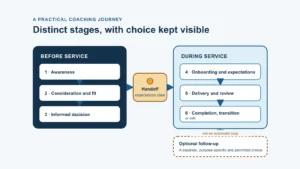
By Islam Abdullah, Founder of Reverse Mindset Academy A clear client journey keeps each stage visible and treats follow-up as a separate choice, not an
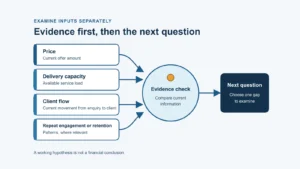
By Islam Abdullah, Founder of Reverse Mindset Academy Look at your offer, available time, enquiries and returning clients, where relevant, before deciding what to change.

By Islam Abdullah, Founder of Reverse Mindset Academy When people talk about business systems, the phrase can sound heavier than the work needs to be.

Explore six connected areas that may affect inconsistent client enquiries—and what to examine before spending more on marketing.

We use cookies to improve your experience on our site. By using our site, you consent to cookies.
Manage your cookie preferences below:
Essential cookies enable basic functions and are necessary for the proper function of the website.
Statistics cookies collect information anonymously. This information helps us understand how visitors use our website.
Optional website statistics for the Client Flow Snapshot. After affirmative Statistics consent, Google Analytics may receive one canonical page view, a scroll-depth event if 90% of the page becomes visible, and the approved start, completion and result-view milestones. Page view and scroll are auxiliary only and are not used as Snapshot completion or result. Snapshot answers, scores, result content, names, email addresses and client information are excluded.
Service URL: policies.google.com (opens in a new window)